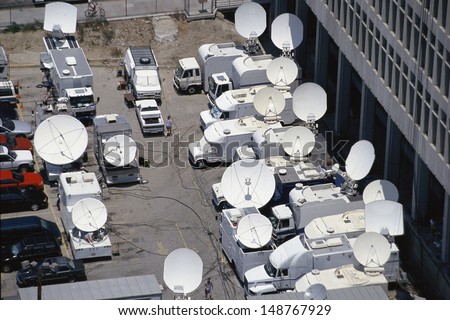
In 1995, the People of the State of California v. Orenthal James Simpson was in full swing, a broadcast circus of proportions never seen before by man. The words ‘trial of the century’ had been thrown about by anyone with a microphone and camera, and with the twentieth century winding down, who could possibly have argued against that rhetoric? Here was a beloved sports figure, spokesman, and actor, pulled in front of a court of law for the brutal murder of two people, hardly three years removed from race-driven riots in the same city. People of the State of California v. Orenthal James Simpson was the microcosmic representation of what we as a nation had allowed to define us.
Celebrity. Brutality. Segregation. and above all, voyeurism.
The trial was reality-television at its most obvious, its most prurient, and its most expensive. Three to six million dollars for his defense. An estimated 480 million dollars in lost productivity as the nation watched it unfold live on TV. Not to mention the costs to the city, county, and state of California to produce this affair for the public’s consumption.
I thought about all of this one day when the reporters, having no news to report on (perhaps the trial was in a lull or the dancing horses had not yet been removed from their corral), were reduced to reporting on the presence of each other. The fleets of trucks parked in lines up and down the street in front of the courthouse, microwave transmitters bristling into the sky like the bristles of a brush. Each reporter staked out in their square of space, a modern-day bazaar where the hawkers sold their faces to the camera and begged the buyers to stay tuned as they waxed poetic on the irony of each, in turn, reporting on the other.
Reporters actually interviewed each other. I remember this distinctly. Close-up ready faces, cut, blown, and styled, babbling to one another in the absence of anything substantial to provide in the way of updates to what would eventually be a long, drawn-out example of the American justice system.
What I wondered about at that time was how much -beyond the court costs, beyond the lawyers fees and judges fees and salaries for the deputies and added security, research needs, paralegals, police over time- how much was spent broadcasting this to the world.
Here was a group of people who chose to spend millions, a population that chose to spend time, energy, effort, and resources, every single minute of every single day, to broadcast the second-by-second minutia of something that, a mere twenty years before, would have been relegated to a series of pastel drawings and three minutes of regard by Harry Reasoner and Howard K. Smith. Here was a farmer’s market, individual stalls packed with their cameras, their microphones, their talking heads, all reporting the over-reporting of the trial of the century.
I thought about the reporter’s salaries. Camera operators. Cables. Lights. Power. Make-up. Electricity. Every minute. Every day. Not pool reporting. Not a court briefing accompanied by some swiftly rendered sketches and on to the next headline. This was dozens of stations repeating the same thing that every other station was saying, day after day after day.
I couldn’t imagine what it cost. Thousands? Tens of thousands? A day? This trial went on for almost nine months. Millions of dollars spent bringing every sordid second to millions of people.
It’s 21 years later and I wonder what we could have invested that money on and what type of return we could have gotten. We got nothing for all of that. Maybe there was a bump in food and hotel sales, maybe a few people made a living pumping out the dreadful tell-alls and cottage industries certainly boomed for ten months selling geegaws and doodads.
But, as a society, what could that money have eventually provided to the people of Flint, Michigan in terms of clean drinking water? What could it have provided as investment to alternative energy resources, limiting dependence on oil and ultimately allowing us to ignore the Middle East in 2003? Instead of hundreds of thousands of troops, we respond with cruise missiles, and how many soldiers come home to be fathers? To be husbands? How many lives are kept from being shattered by IEDs and shell shock? What return would it have shown in research on pediatric cancers, infrastructure upgrades, and secondary education for people everywhere?
I understand that it’s the consumer driving this dreadful marketplace. We’re all of us neonates in the march of evolution. We’ve been a viable species, as-is, for 200,000 years. We’ve had civilization for 6,000 years, and of that, only 200 carrying modern industrial and technological process.
Comparing that to the span of dinosaurs, we’ve existed for less that .2% of their time on Earth, been civilized for 3% of that span, and technologically savvy for 3% of that time. We have had less than 2 millionths the time that dinosaurs had. We are still, sociologically, infants crawling around in a pile of sugar, quick to scream and throw tantrums when our sticky fingers are kept from cramming these precious flavors into our mouths.
Yet what we are currently capable of, as an entire people, as a world, surpasses anything up to this point, despite the millions of years invested in everything that came before us.
Imagine if we could colonize Mars in fifty years?
Imagine if we could educate the globe?
Imagine if everyone on earth lived without being hungry or thirsty?
Imagine if, instead of a 7 billion directions, we all pointed in one?
Galactivism is the idea that, as a global society, we should be working to pay forward all that we do to make things easier, better, and safer to provide a better return for the generations that come after us. It is the idea that we work not for what comes tomorrow, or what comes next year, but what comes next generation, and the generation after that. because waiting until the next generation to make things better, that just means we waited too long.
Galactivism is not an easy sell. I know too many people terrified of everything, full of fear and anger at the world. They think they are owed not only what is theirs, but that they are owed the knowledge that others go without.
How horrible is that? The idea that it is not enough for you to have but also, in order for it to be enough, others must have not. There are people who hate the idea of foreign aid. There are people who hate the idea of a minimum living wage. There are people that hate the idea that tax revenues feed poor children and give them a warm place to live.
“It is not enough for others to be fully fed, unless I am fed twice as much.”
And I have never seen the hate fed by their own poverty. I have never had a poor person, skin stretched over the bones and belly distended from malnutrition, complain to me that foreign aid has fed someone on the African Continent. It’s always been someone who actually has something. They have a job. They have a home. They have a car. They have a growing cable bill and growing credit card debt and growing waist line and goddammitall the reason their cable bill is so damn high and their credit card bills are so high and the reason their cholesterol medication is so damn high is because we’re squandering all of dollars feeding children and buying them clothes.
So, no, Galactivism is not an easy sell at all. The idea that what you have is just plenty, and you don’t need any more, is not one that people love to advocate. Nor is the concept that you can direct your effort, energy, money, and time to something with a far larger return for the whole of the world rather than get a new game console, or TV, or car, or third vacation home, is not the type of label for a box that is flying off of the shelves.
Instant gratification is some tough competition to overcome.
But I have put it on the shelf, and I will keep it dusted off the best I can.
I don’t know what’s at the end of this life of mine. Could be nothing, could be paradise. Regardless of where this road stops, I think it might be in everyone’s best interest if some of us seek out the ways we’re pushing the progress of the pilgrims on the spinning mote of dust, and talk about how investing now, going forward, in the progress of the entirety of man, for a return that you will never see or experience, just may be the most rewarding thing of all.
Disagree? Love the way it sounds? Let me know, and we’ll keep the conversation going, and keep the dust off our new product.
 The Galactivist