The System is fine

Let us never forget that government is ourselves and not an alien power over us. The ultimate rulers of our democracy are not a President and senators and congressmen and government officials, but the voters of this country.

Franklin D. Roosevelt

The system is fine.

We bear witness to the assassination of reason, to the nadir of rational discourse, and to the rise of the smarmy, self-absorbed, cult of personality that the American political landscape has become. But I assure you that the system is fine. Everything that our democratic experiment is designed to do still happens. The gears still turn. The pieces still connect. And the horrid-tasting product that it plops onto the conveyor and trundles along to our waiting mouths is colored and flavored exactly as intended by the Founding Fathers.

Our system is fine. The government offices do exactly what they are elected and appointed to do, and the political parties do exactly what we ask them to.

The failure is ours. We hold all of the power in our hand and simply wipe it on our jeans while we go to distract ourselves with cheap products, terrible services, and pointless endeavors. We barely exercise our right to vote, refuse opportunities for civic service, and poke a stick at the darkness with our back to our own fire when the monsters start pulling triggers, punching gas pedals, or swinging axes. Even when we do vote, we flick a lever or punch a chad or tap a video screen with begrudging effort, pushing ourselves back from the table of democracy as quickly as we can to avoid being asked to help with the dishes.

We lament a two-party system, at the adversarial us-versus-themness of it all. We rage at the unfairness of opposing forces locked into inactivity, of the lack of real choices, of actual options to represent us.

Well, why the hell should there be so many choices?

Look at what a glut of information has turned us into? You can hardly stroll down a single pavestone along the information superhighway before the fusillade of anger, hatred, greed, and pride comes tearing into you like a 50-caliber machine-gun loaded with endless belts of words poisoned by panic and fear. Our choices of interaction and communication, while endless, have been sharpened by our own hands into our singular spears that we use to jab at everyone around us.

Even when we manage to stumble across like-minded dread-eaters, we manage to only gather around that dim fire we share and shake our spears out into the darkness. And woe should we find fault with that tribe, for we’ll banish it, or ourselves, shaving and sanding down our comrades until the pin-point accuracy of our wants and desires are echoed completely, and we’ve found ourselves a nation comprised of 370 million individual tribes.

Compromise is lost. Tolerance is lost. Our tribes are all or nothing. And the nascent anonymity of usernames and fake profiles that once allowed the most angry and fearful of us to post all of our prejudices behind a digital mask has now evolved into the far more lurid anonymity of the mob. Impunity is held in the left hand while the other hand hurls the brick, knowing that apathy, exhaustion, or sympathy will still the hand of the remaining tribes when they move to banish the attacker.

When we demand that unwavering obedience by all to only our point of view, and 370 million points of view demand the same, how do you think that would look in the political arena? Ask Turkey what a coalition government demanding accountability from the leaders actually looks like.


No, the system is just fine. We could dynamite the lobbying system and strip the over-reaching eyes and ears of Big Brother and crush the corporate stranglehold on government in twelve years if we actually wanted. Three presidential cycles and two senate cycles to prove that not doing your job gets you fired. Easy as that.

But our tribes hate each other more than they hate the system. The Reds hate the Blues so much they will do anything to destroy the Blues. The Blues hate the Reds so much, they will do anything to destroy the Reds.

Compromise is lost. Tolerance is lost. Our tribes are all or nothing

Stop saying it’s the system that is broken. We are the system, and we break it or fix it at our leisure.

We are currently a nation on the phone screaming at the internet-provider

God forbid someone suggests its user error.


looking forward June 17th 2016

I have a rather large yard, nearly an acre. With the house and some areas where the trees have shaded the grass and delivered it from growth, that still leaves a considerable amount of lawn to mow. The lawnmower I own is a self-propelled gas-powered walk-behind, needing 3 hyphens to describe it and 85 minutes on average for it to mow the entire yard.

My neighbor, my wife, my co-workers have all sung a similar tune in their inquiry.

“Why not get a riding mower?”

Riding mower. Sure is quicker to say, and probably would cut down considerably on the time needed to mow the lawn.

The quickest solution would indeed be to drop a grand or two on a riding mower. Quicker mow. Done and done. Swift sculpting of wide swaths of blank yard then back to the rest of my day.

I have instead taken the avenue of attack that has me reducing the amount of lawn needed to mow, rather than simply getting more mower. I have a deck planned, and some landscaping, and every bit I plan and install, cuts down my mowing time and builds to the curb-appeal and use-ability of the yard. A gazebo is planned, and a large deck, and a fire-pit swing-set.

This will certainly take longer, will not be easier, and will let me make a much better use of my yard. It’s design is specific to having more people use my lawn with me.

Because ultimately I’m a rich white guy. Not an “American rich white guy”. Oh no, nothing like that. I called a friend of mine a “rich white guy” a few weeks ago and he was quick to correct me that he wasn’t rich. I didn’t have a stack of pictures from Kibera, Karachi, or District 9 in order to disabuse him of the notion that he wasn’t well-off, at least in the global sense.

Yeah, you caught me. District 9 was a movie. But the filming was done in an actual Johannesburg slum. 

In the global village, in the earthly metropolis that is this planet hurtling through space, I am better off than the vast majority of people, and if inviting my friends and neighbors to share at my table is a component of The Galactivist, than that’s fine with me. And the tilted table we eat off of is an essay for another day.

So, what does this have to do with anything?

I find parallels for my views on my lawn with the current debate regarding guns. I think far too much argument has gone on with regard to the metaphorical need for a smaller or larger mower, and not enough on limiting the need for a mower at all.

I understand the Second Amendment and support it fully, because I don’t trust our government to do the right thing all the time. I don’t think that our leaders would be foolish enough to direct martial forces against We The People, their cash cow. We’re not Iraq, or Saudi Arabia, or Nigeria. We don’t get our money from resources pulled from the ground by slaves. Our power comes from the tax base, and the more citizens paying into the circus the better. Mowing down a few million of us would negatively affect their profit margin and that’s the last thing that they want. So, at this specific juncture in human evolution, there is still a need for a very real fear in the United States for armed insurrection and rich people being shot in their homes to keep the monsters in power a tad fearful of pushing the boundaries too far. The second Amendment, the separation of powers, and our ‘peaceful’ rebellions every four years keeps that further from us than the end-of-times depressives would have you believe.

So I fail to see the need for someone to need an assault style rifle to defend themselves or their home. The numbers for defense with rifles just don’t add up. I get that people feel ‘safer’, and I think it’s all driven by fear and money, the top two enemies of the Galactivist in practice. Preying on human fear and weakness for profit is the most American of art forms, right up there with jazz and comic books. And I do not find any progress in a debate where one side is afraid that their guns are going to be confiscated, and another side that wants them banned for all the wrong reasons.

Confiscate your gun? Gods forbid. It should never come to that. Instead, we should work on reducing the fear that drives us to clench these weapons tighter and tighter, like a steel placebo in the hands of the frightened.

I will strive to make my proverbial yard somewhere to relax and contemplate, and less of a burden of labor that needs to be tended to as quickly and easily as possible. My conviction is that we need to build the dialogue of this with a goal of community growth in mind, and without the goals of profit and threat.

Looking forward June 16th 2016

Happy Captain Picard Day!

In the interest of a life paid forward, we celebrate today with NASA’s intent to get to Mars. Their Journey To Mars certainly blasts beyond the movies and Disney rides in an effort to understand what it will take to get us to the Fourth Rock from the Sun. The considerations of what challenges lie ahead for a journey of this magnitude, and the innovations it will drive, are exactly the type of thinking and teamwork we need as a race.


Galactivism

Galactivism

In 1995, the People of the State of California v. Orenthal James Simpson was in full swing, a broadcast circus of proportions never seen before by man. The words ‘trial of the century’ had been thrown about by anyone with a microphone and camera, and with the twentieth century winding down, who could possibly have argued against that rhetoric? Here was a beloved sports figure, spokesman, and actor, pulled in front of a court of law for the brutal murder of two people, hardly three years removed from race-driven riots in the same city. People of the State of California v. Orenthal James Simpson was the microcosmic representation of what we as a nation had allowed to define us.

Celebrity. Brutality. Segregation. and above all, voyeurism.

The trial was reality-television at its most obvious, its most prurient, and its most expensive. Three to six million dollars for his defense. An estimated 480 million dollars in lost productivity as the nation watched it unfold live on TV. Not to mention the costs to the city, county, and state of California to produce this affair for the public’s consumption.

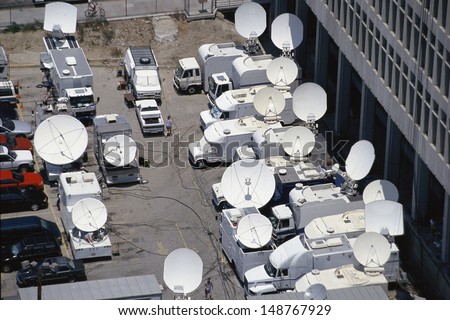
I thought about all of this one day when the reporters, having no news to report on (perhaps the trial was in a lull or the dancing horses had not yet been removed from their corral), were reduced to reporting on the presence of each other. The fleets of trucks parked in lines up and down the street in front of the courthouse, microwave transmitters bristling into the sky like the bristles of a brush. Each reporter staked out in their square of space, a modern-day bazaar where the hawkers sold their faces to the camera and begged the buyers to stay tuned as they waxed poetic on the irony of each, in turn, reporting on the other.

Reporters actually interviewed each other. I remember this distinctly. Close-up ready faces, cut, blown, and styled, babbling to one another in the absence of anything substantial to provide in the way of updates to what would eventually be a long, drawn-out example of the American justice system.

What I wondered about at that time was how much -beyond the court costs, beyond the lawyers fees and judges fees and salaries for the deputies and added security, research needs, paralegals, police over time- how much was spent broadcasting this to the world.

Here was a group of people who chose to spend millions, a population that chose to spend time, energy, effort, and resources, every single minute of every single day, to broadcast the second-by-second minutia of something that, a mere twenty years before, would have been relegated to a series of pastel drawings and three minutes of regard by Harry Reasoner and Howard K. Smith. Here was a farmer’s market, individual stalls packed with their cameras, their microphones, their talking heads, all reporting the over-reporting of the trial of the century.

I thought about the reporter’s salaries. Camera operators. Cables. Lights. Power. Make-up. Electricity. Every minute. Every day. Not pool reporting. Not a court briefing accompanied by some swiftly rendered sketches and on to the next headline. This was dozens of stations repeating the same thing that every other station was saying, day after day after day.

I couldn’t imagine what it cost. Thousands? Tens of thousands? A day? This trial went on for almost nine months. Millions of dollars spent bringing every sordid second to millions of people.

It’s 21 years later and I wonder what we could have invested that money on and what type of return we could have gotten. We got nothing for all of that. Maybe there was a bump in food and hotel sales, maybe a few people made a living pumping out the dreadful tell-alls and cottage industries certainly boomed for ten months selling geegaws and doodads.

But, as a society, what could that money have eventually provided to the people of Flint, Michigan in terms of clean drinking water? What could it have provided as investment to alternative energy resources, limiting dependence on oil and ultimately allowing us to ignore the Middle East in 2003? Instead of hundreds of thousands of troops, we respond with cruise missiles, and how many soldiers come home to be fathers? To be husbands? How many lives are kept from being shattered by IEDs and shell shock? What return would it have shown in research on pediatric cancers, infrastructure upgrades, and secondary education for people everywhere?

I understand that it’s the consumer driving this dreadful marketplace. We’re all of us neonates in the march of evolution. We’ve been a viable species, as-is, for 200,000 years. We’ve had civilization for 6,000 years, and of that, only 200 carrying modern industrial and technological process.

Comparing that to the span of dinosaurs, we’ve existed for less that .2% of their time on Earth, been civilized for 3% of that span, and technologically savvy for 3% of that time. We have had less than 2 millionths the time that dinosaurs had. We are still, sociologically, infants crawling around in a pile of sugar, quick to scream and throw tantrums when our sticky fingers are kept from cramming these precious flavors into our mouths.

Yet what we are currently capable of, as an entire people, as a world, surpasses anything up to this point, despite the millions of years invested in everything that came before us.

Imagine if we could colonize Mars in fifty years?
Imagine if we could educate the globe?
Imagine if everyone on earth lived without being hungry or thirsty?
Imagine if, instead of a 7 billion directions, we all pointed in one?

Galactivism is the idea that, as a global society, we should be working to pay forward all that we do to make things easier, better, and safer to provide a better return for the generations that come after us. It is the idea that we work not for what comes tomorrow, or what comes next year, but what comes next generation, and the generation after that. because waiting until the next generation to make things better, that just means we waited too long.

Galactivism  is not an easy sell. I know too many people terrified of everything, full of fear and anger at the world. They think they are owed not only what is theirs, but that they are owed the knowledge that others go without.

How horrible is that? The idea that it is not enough for you to have but also, in order for it to be enough, others must have not.  There are people who hate the idea of foreign aid. There are people who hate the idea of a minimum living wage. There are people that hate the idea that tax revenues feed poor children and give them a warm place to live.

“It is not enough for others to be fully fed, unless I am fed twice as much.”

And I have never seen the hate fed by their own poverty. I have never had a poor person, skin stretched over the bones and belly distended from malnutrition, complain to me that foreign aid has fed someone on the African Continent. It’s always been someone who actually has something. They have a job. They have a home. They have a car. They have a growing cable bill and growing credit card debt and growing waist line and goddammitall the reason their cable bill is so damn high and their credit card bills are so high and the reason their cholesterol medication is so damn high is because we’re squandering all of dollars feeding children and buying them clothes.

So, no, Galactivism  is not an easy sell at all. The idea that what you have is just plenty, and you don’t need any more, is not one that people love to advocate. Nor is the concept that you can direct your effort, energy, money, and time to something with a far larger return for the whole of the world rather than get a new game console, or TV, or car, or third vacation home, is not the type of label for a box that is flying off of the shelves.

Instant gratification is some tough competition to overcome.

But I have put it on the shelf, and I will keep it dusted off the best I can.

I don’t know what’s at the end of this life of mine. Could be nothing, could be paradise. Regardless of where this road stops, I think it might be in everyone’s best interest if some of us seek out the ways we’re pushing the progress of the pilgrims on the spinning mote of dust, and talk about how investing now, going forward, in the progress of the entirety of man, for a return that you will never see or experience, just may be the most rewarding thing of all.

Disagree? Love the way it sounds? Let me know, and we’ll keep the conversation going, and keep the dust off our new product.